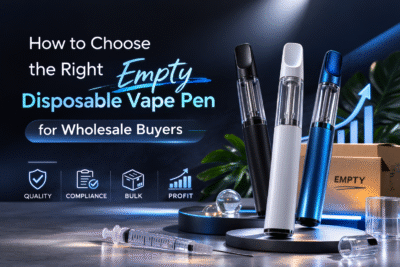
Empty hardware only. This article discusses hardware components (empty disposables, empty shells, packaging, batteries, QC and logistics). It does not include any oil, nicotine, THC, or filling instructions.
Best Disposable Vape Pen for Disposable Bulk: A Best Vape Wholesale Buyer’s Checklist
“Best” means something different in B2B than it does in consumer reviews. For wholesale teams, the best disposable vape pen is the one that stays consistent across batches, survives shipping, and reduces returns—while keeping your landed cost predictable. This checklist is built for distributors, brand owners, and procurement teams buying empty hardware at scale.
1) Define “best” for B2B procurement
What “best” looks like
- Repeatable build: the same SKU behaves the same across lots.
- Low return drivers: fewer leaks, scratches, weak seals, or DOA electronics.
- Stable packaging: boxes remain sellable after parcel handling.
- Documentable: battery/shipping paperwork exists when carriers ask.
What “best” is NOT
- Not just the lowest unit price on a quote sheet.
- Not a one-time “perfect sample” that can’t be repeated in production.
- Not packaging that photographs well but crushes in transit.
- Not “trust me”—without lot codes and QC records.
B2B win condition: low total cost per sellable unit—not “cheap once, expensive later.”
2) Hardware spec checklist (what to lock)
Before you buy disposable bulk, lock a spec sheet that your supplier must match every time. Even if your customers say “best disposable vape pen,” your purchasing team should translate that into: materials, tolerances, and a known-good “golden sample.”
Core specs to define
- Materials: tank/chamber material, mouthpiece material, gasket type and placement.
- Seal strategy: how leak resistance is achieved (gasket geometry, press-fit, weld points).
- Airflow path: intake placement and consistency across units (avoid random variance).
- Finish & cosmetics: color tolerance, coating/paint rub resistance, seam alignment.
- Pack-out: inner tray/sleeve, carton count, corner protection, label zones.
Practical compatibility notes (no filling instructions)
You don’t need to disclose formulations to run a smart hardware program. But you should confirm the hardware is intended for your target viscosity range and your customer’s expected draw profile. Do this via controlled sampling and acceptance criteria—not with guesswork.
Keep it simple: define pass/fail behaviors, document them, and stick to the same checks each reorder.
3) QC gates: sample → pilot → production
The fastest way to scale a “best vape wholesale” program is to make QC boring and repeatable. Use three gates:
Gate A — Golden sample approval
Approve a sample that represents the exact cosmetic finish, assembly feel, and packaging dielines you want. Store one sealed unit as the “golden” reference and compare every future batch to it.
Gate B — Pilot run (small batch)
Run a small batch using real production tooling and real packaging. Confirm your top failure modes: seal integrity, cosmetic abrasion, packaging crush risk, and any electronic DOA rates.
Gate C — Production inspection
Inspect each bulk shipment against written defect definitions (critical/major/minor) and use consistent sampling rules. Consistency matters more than perfection.
4) AQL sampling: how to keep inspection repeatable
Many buyers rely on ISO-style acceptance sampling (often discussed as AQL-based plans) to avoid 100% inspection while keeping risk controlled. ISO 2859-1 describes an acceptance sampling system indexed by AQL for lot-by-lot inspection. If you use a third-party QC partner, ask them to align inspection logic to ISO 2859 tables and clearly document the defect thresholds.
What to define in writing (example)
- Critical: safety risk, liquid-path leakage at seal points, or hazardous electrical behavior (reject lot).
- Major: severe cosmetic damage, missing components, broken charging function.
- Minor: small scuffs that don’t affect sellability (define tolerance).
The exact thresholds are your business decision—what matters is having a repeatable standard every time.
5) Packaging durability: what parcel shipping breaks
Packaging is a protection system. In parcel delivery networks, products face drops, random vibration, compression, and corner impacts. ISTA Procedure 3A is widely referenced as a parcel-delivery simulation for packages up to 150 lb (70 kg), which makes it a practical benchmark when you design cartons and inserts.
Common failure points
- Corner crush from stacking/compression
- Rattle damage when inserts are loose
- Scuffing from friction during vibration
- Label/UPC zones placed on curved or low-contrast areas
What to standardize
- Dielines + bleed + board grade
- Insert geometry to prevent motion
- Carton pack count + dividers
- Drop-test mindset (design for stress)
6) Traceability: batch IDs, cartons, and dispute defense
In disposable bulk, traceability reduces chaos. Lot IDs on master cartons and inner packs help you: (1) isolate issues to specific shipments, (2) defend chargebacks with evidence, and (3) improve reorders with real feedback.
Minimum traceability kit
- Lot/Batch ID printed or labeled on master cartons
- Consistent SKU naming across invoices, cartons, and inner packs
- Photo log of first-article units from each production run
- QC report linked to the PO and carton lot labels
7) Battery & shipping docs (high level)
Many disposable hardware SKUs include lithium cells. For transport, lithium cells/batteries must have passed design tests in UN 38.3, and in the U.S. PHMSA guidance explains that manufacturers must make lithium battery test summaries available upon request. If you’re buying “best disposable vape pen” hardware for wholesale distribution, confirming these documents early helps prevent carrier delays.
Documents buyers commonly request
- UN 38.3 evidence (design tests requirement)
- Lithium battery test summary (availability requirement per PHMSA guidance)
- Safety testing references such as IEC 62133-2 or UL 8139 (where relevant)
This section is intentionally high-level because requirements vary by configuration and transport mode.
8) A clean RFQ template for comparable quotes
Quotes become meaningless when each supplier is quoting different assumptions. Keep your RFQ structured:
- Hardware type: empty disposable / empty shell / packaging-only / battery-only
- Spec sheet: materials, cosmetics, pack-out, label zones
- QC terms: defect classes + sampling approach
- Packaging scope: box style, insert, finishing (UV, foil, matte)
- Logistics: carton counts, lead times, required documents (if batteries)
If your supplier can answer these cleanly, you’re operating a program—not gambling on one-off batches.
9) FAQ
Is “best disposable vape pen” a consumer term? Can B2B use it?
Yes—use it to capture search intent, then translate it into B2B criteria: repeatability, QC gates, packaging durability, and documentation.
What’s the fastest way to reduce returns in disposable bulk?
Lock a golden sample, run a pilot, and hold production to written defect definitions with repeatable sampling. Most costly failures come from variance, not from a single obvious defect.
How many internal links should a buyer-checklist post have?
Use a reader-first approach and keep anchors descriptive. In this post, we’ve included the three required links and kept them clearly labeled.
© AVapeBulk. Educational content for B2B sourcing of empty hardware and packaging workflows only.

 ACE Ultra
 Muha Meds
 Big chief
 Besos
Besos Cookies
 Packman
 Tyson pod
 California Honey
 Jungle boys
 Packwoods