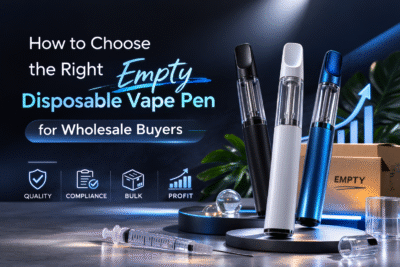
Empty hardware only. This post focuses on empty disposable hardware, packaging, QC workflows, traceability, and logistics documentation. It does not include oil, nicotine, THC, or any filling instructions.
1) Why repeatable quality matters in bulk
In wholesale, quality problems don’t show up as a single bad unit — they show up as a pattern: a spike in returns, cartons that arrive unsellable, or an argument about whether a defect was “already there.” The larger the category gets, the more costly variance becomes. Analysts disagree on exact numbers, but multiple industry reports still point to a large and growing global vape market — which means more SKUs, more suppliers, and more opportunities for inconsistent builds if you don’t standardize your program.
The goal isn’t “perfect once.” It’s predictable sellable units per shipment.
2) Spec lock: the fastest way to reduce variance
Think like procurement, not like a product photo
- Golden sample: keep a sealed reference unit that future lots must match (feel, fit, finish).
- Material declarations: define chamber/tank material, gasket type, and mouthpiece material.
- Cosmetic limits: write what “sellable” means: scuff tolerance, seam alignment range, color drift.
- Pack-out definition: tray/insert, inner box, carton count, and protection at corners/edges.
Spec lock is how you turn “looks good in a sample” into “ships the same way in production.”
3) QC gates that scale (without 100% inspection)
Gate A — Sample approval (reference only)
Approve cosmetics, assembly feel, and packaging dielines as one system. Document it with photos, notes, and a simple pass/fail checklist. The outcome is your “this is what we mean by good.”
Gate B — Pilot run (variance detector)
A pilot run reveals what samples hide: rubbing during transit, inconsistent assembly pressure, or packaging that looks premium but doesn’t protect. Treat the pilot as a stress test for your acceptance criteria.
Gate C — Production inspection (repeatable decisions)
Define defect classes (critical/major/minor) and keep the definitions stable across reorders. If your definitions change every month, your results will look random — and supplier improvement becomes impossible to measure.
4) Sampling plans: making inspection boring on purpose
Bulk programs often rely on acceptance sampling to control risk without inspecting everything. ISO 2859-1 describes a sampling scheme indexed by AQL for lot-by-lot inspection — the practical takeaway is not the table numbers, but the discipline: same lot size logic, same defect definitions, same record format every shipment.
What to standardize in your QC report
- Lot identity: PO, SKU, carton count, and lot/batch ID on the report header.
- Inspection method: sampling logic used, and the exact checks performed.
- Defect photos: clear images tied to the lot ID (not random phone screenshots).
- Disposition: accept, rework, partial hold, or reject — with a one-sentence reason.
5) Packaging durability: design for parcel reality
Packaging is a protection system, not a design exercise. Parcel networks introduce drops, vibration, compression, and corner impacts. ISTA’s Procedure 3A is commonly referenced as a parcel-delivery simulation for packages up to 150 lb (70 kg), making it a practical benchmark mindset for consumer-like shipments.
Typical breakpoints
- Corner crush that ruins shelf appearance
- Loose inserts that allow internal “rattle abrasion”
- Low-friction coatings that scuff during vibration
- Barcode/label zones placed on curves or low-contrast areas
Packaging controls that scale
- Board grade and box structure locked per SKU
- Insert geometry that prevents motion
- Carton pack count with dividers where needed
- Drop-test mindset: protect edges and corners first
6) Lot IDs + evidence: the dispute-defense layer
Traceability turns a vague complaint into a solvable ticket. In bulk, the minimum effective system is: lot ID on cartons, consistent SKU naming, and a QC report tied to the PO. When something goes wrong, you can isolate the issue, quarantine the right inventory, and avoid punishing good lots for a bad one.
Minimum traceability kit (simple but powerful)
- Lot/Batch ID label on master cartons (and ideally inner packs)
- Photo log of first-article units per lot
- QC report stored with the PO and shipping documents
- Clear “what changed?” notes for each reorder (supplier, material, packaging revision)
7) Lithium shipping docs (high-level) and why to request early
Many disposable hardware SKUs include lithium cells. For transport, lithium cells/batteries must have passed the UN Manual of Tests and Criteria Section 38.3 design tests, and PHMSA explains that manufacturers must make lithium battery test summaries available upon request in the supply chain. Requesting these before peak shipping prevents last-minute carrier delays.
Documents buyers commonly request
- UN 38.3 evidence (design test requirement)
- Lithium battery test summary (make available upon request)
- Other safety references (when relevant to your device configuration)
This section stays high-level intentionally: exact requirements vary by configuration and transport mode.
8) How a vape online store operationalizes all of this
The store layer is where the system becomes repeatable. You’re not just listing products — you’re managing variance. A strong wholesale operation typically runs four loops:
Loop 1 — Supplier scorecards (make quality measurable)
- Track defects by lot and by failure mode (cosmetic, packaging, DOA electronics, missing parts).
- Score on-time delivery + documentation completeness, not price alone.
- Require change control: if materials/packaging change, it’s a “new revision,” not “same SKU.”
Loop 2 — Inbound QC logging (evidence, not opinions)
- Standard photo angles (boxing, labels, internal trays, first-article units).
- Consistent QC templates to keep inspection decisions repeatable.
- Fast quarantine rules for lots with matched defect signatures.
Loop 3 — Packaging reality checks (sellable arrival rate)
- Test “arrival cosmetics,” not just “factory cosmetics.”
- Fix corner protection and internal motion before changing coatings or colors.
- Standardize carton counts to reduce random compression outcomes.
Loop 4 — RMA feedback (turn returns into reorders)
- Tag returns by lot ID and vendor batch, not just by SKU name.
- Use a short “What failed?” checklist so customers describe issues consistently.
- Feed the top 3 failure modes into the next pilot run acceptance criteria.
The win condition is simple: fewer surprises per carton, faster root-cause isolation, and cleaner reorders.
FAQ
Does “bulk quality” mean I need 100% inspection?
Not necessarily. Many programs scale by standardizing defect definitions, using repeatable sampling logic, and keeping strong traceability so issues can be isolated quickly.
What should I lock first: specs or packaging?
Lock both as a system. Many “hardware issues” are actually packaging-in-transit issues (scuffs, crush, rattle abrasion). Start with a golden sample plus pack-out definition.
How do I keep reorders consistent across months?
Use revision control. If anything changes (materials, insert, finishing), treat it as a new revision with a pilot run — then update your golden sample.

 ACE Ultra
 Muha Meds
 Big chief
 Besos
Besos Cookies
 Packman
 Tyson pod
 California Honey
 Jungle boys
 Packwoods