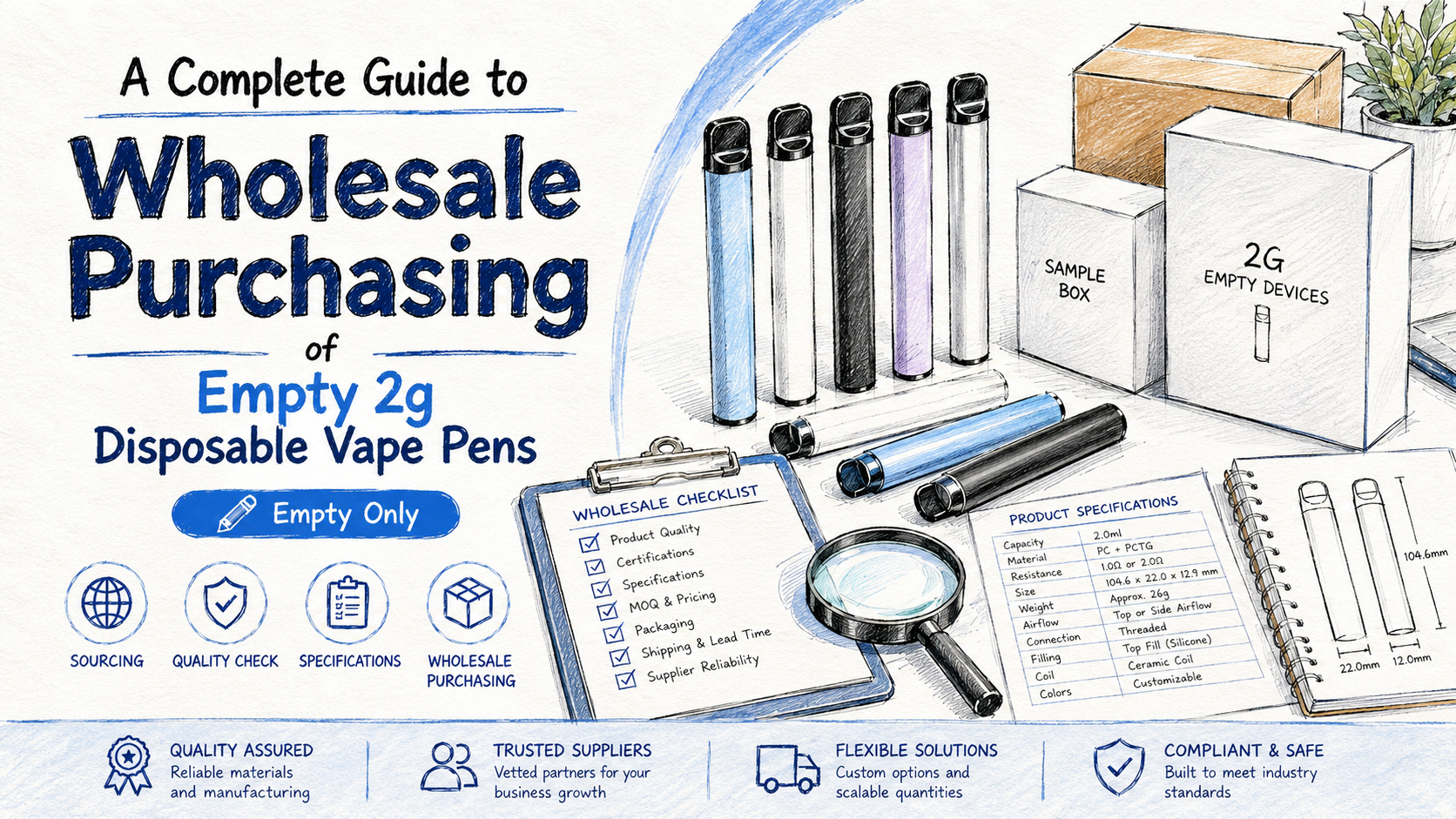
Wholesale purchasing of empty 2g disposable vape pens requires more than comparing a unit price. A careful buyer defines the product clearly, checks samples, reviews written specifications, confirms order terms, and verifies the requirements that apply in the destination market.
What “Empty Only” Means
In this guide, empty only means the product is supplied unfilled. It does not include oil, liquid, nicotine, THC, CBD, flavoring, or another active substance. This wording should appear consistently in the quotation, pro forma invoice, packing list, product page, and final order confirmation.
Buyers comparing empty 2g disposable vape pens should confirm that every selected listing uses clear empty only wording. The broader empty disposable vape category can also help buyers compare capacity groups, formats, and product families before preparing a shortlist.
Important: Empty only is a product description, not a legal classification. Import, labeling, filling, age-restriction, marketing, and resale obligations may differ by country, state, or region.
1. Prepare a Clear Purchasing Brief
A useful purchasing brief reduces mistakes before quotation. Keep it short, measurable, and easy for more than one supplier to answer.
Required quantity and expected reorder frequency
Nominal 2g or 2ml capacity wording
Single-tank or dual-chamber format
Preferred coil and airflow configuration
Filling-port and mouthpiece requirements
Logo, artwork, color, and packaging requirements
Destination country and requested delivery term
Required production, inspection, and dispatch dates
Use the same brief for each quotation. A consistent request makes price, MOQ, lead time, packaging, and included services easier to compare.
2. Confirm What “2g” Represents
The term 2g may be used as a commercial category name, while technical documents may describe reservoir volume in milliliters. Do not rely on the product name alone. Ask the supplier to confirm the stated capacity, tolerance, internal layout, dimensions, and whether a dual-chamber format divides the total capacity between two separate reservoirs.
Record the agreed measurement in the purchase order. Product-page wording, quotation wording, packaging text, and inspection criteria should match.
3. Review Samples Before a Bulk Order
A sample review gives the buying team a practical reference for approval. Buyers can compare empty vape samples before confirming a larger quantity.
What to Check
Outer finish, dimensions, print position, and color consistency
Reservoir clarity, seals, airflow path, and filling-port access
Mouthpiece fit and assembly consistency
Coil placement and visible material consistency
Packaging protection, labels, barcodes, and carton marks
Whether every sample is supplied empty only
Keep an approved sample and an approval record. For repeat orders, compare production units against that reference rather than relying on memory or photographs alone.
4. Read a Product Listing as a Specification Summary
A product page can help a buyer identify the commercial name, capacity, order quantity, stock location, and packaging format, but it should not replace written order terms. A listing such as the Wizard Trees 2g empty disposable can be used as a reference when building a specification checklist.
Before payment, ask for written confirmation covering the exact model, empty only status, quantity, unit price, packaging, customization, inspection standard, lead time, dispatch point, and after-sale process.
5. Evaluate the Supplier, Not Just the Product
A low quotation is not useful when specifications are unclear or communication changes after payment. A practical supplier review should cover business identity, production responsibility, order documentation, quality records, sample consistency, capacity planning, and issue resolution.
Who is responsible for production and final inspection?
Can the supplier provide a written specification sheet?
How are lot numbers and inspection records managed?
What happens if delivered goods differ from the approved sample?
Which customization items require a higher MOQ?
Which costs are included in the quoted price?
Where relevant, buyers can review the official overview of ISO 9001 quality management. A reference to ISO 9001 should not be treated as proof of certification. Request current certification details when a supplier makes that claim.
6. Compare the Full Commercial Offer
Wholesale comparisons should be based on the total commercial offer rather than the headline unit price. Ask each supplier to separate included and excluded costs.
Item
What to Confirm
MOQ
Minimum quantity by model, color, artwork, and packaging option
Pricing tiers
Unit price at the quantities your business can realistically reorder
Samples
Sample cost, shipping, approval process, and whether the sample cost is credited later
Customization
Artwork setup, printing, packaging, proofing, and revision charges
Inspection
Inspection method, acceptance criteria, reporting, and responsibility for nonconforming goods
Delivery
Dispatch point, trade term, freight, customs responsibility, and estimated transit time
Payment
Deposit, balance timing, accepted method, invoice details, and refund terms
7. Put Quality Requirements in Writing
General phrases such as “good quality” are difficult to inspect. Replace them with observable requirements. Define accepted dimensions, print position, color tolerance, packaging condition, assembly consistency, seal condition, and permitted defect levels.
A written inspection plan may include:
Pre-production confirmation of specifications and artwork
In-process checks during assembly and printing
Final random inspection against the approved sample
Carton-count and shipping-mark verification
Photographic or written inspection records
Do not present a certificate, report, or supplier statement as broader proof than it actually provides. Check the issuing organization, document scope, model coverage, date, and current validity.
8. Plan Packaging and Labeling Early
Packaging approval often affects MOQ and lead time. Confirm artwork dimensions, print method, required warnings, importer information, barcodes, carton labels, and language requirements before mass production.
Brand owners should also confirm that names, logos, graphics, and packaging elements are authorized for use. A supplier’s ability to print artwork does not establish ownership or permission.
9. Check Import and Market Responsibilities
Each buyer should determine the requirements that apply to the exact product configuration and destination market. In the United States, official information on U.S. importer responsibilities is available from U.S. Customs and Border Protection.
Buyers assessing U.S. tobacco-product requirements can also review the FDA’s current ENDS information.
These resources are starting points, not a substitute for advice on a specific shipment. Classification and obligations may depend on product configuration, intended use, claims, packaging, destination, and later filling or resale activity.
10. Use a Written Purchase Order
The final purchase order should reflect the approved quotation and sample. Avoid relying on chat messages spread across several platforms.
Purchase-Order Checklist
Supplier and buyer legal names
Exact product name and model reference
Empty only statement
Capacity wording and agreed specifications
Quantity, unit price, and total value
Packaging and customization details
Inspection method and acceptance criteria
Lead time, dispatch point, and delivery term
Payment schedule and invoice details
Procedure for shortages, defects, or specification differences
Common Wholesale Purchasing Mistakes
Assuming every “2g” listing uses the same capacity definition
Skipping sample approval because product photos look similar
Comparing unit price without packaging, inspection, and delivery costs
Accepting verbal promises that are absent from the purchase order
Using unclear wording instead of a direct empty only statement
Ordering branded packaging without confirming authorization
Assuming a supplier certificate covers every model and production lot
Ignoring destination-market import, labeling, and resale requirements
Final Buyer Checklist
Before approving a wholesale order, confirm the following:
The exact model and capacity are defined.
The product is described as empty only in every key document.
A representative sample has been reviewed and approved.
MOQ, price tiers, customization, and packaging costs are clear.
Quality requirements and acceptance criteria are measurable.
Lead time, dispatch location, and delivery responsibilities are written.
Brand and artwork permissions have been checked.
Import, labeling, filling, and resale obligations have been reviewed for the destination market.
Frequently Asked Questions
Are empty 2g disposable vape pens pre-filled?
No. In this guide, empty only means no oil, liquid, nicotine, THC, CBD, flavoring, or other active substance is included.
Should buyers choose a supplier based on price alone?
No. Buyers should also compare specifications, samples, MOQ, production capacity, inspection terms, packaging, lead time, documentation, and after-sale procedures.
Why should a sample be approved before a bulk order?
A sample provides a physical reference for dimensions, finish, assembly, airflow, seals, printing, and packaging. It also gives the buyer a clearer basis for final inspection.
Does empty only automatically determine legal treatment?
No. Empty only describes the supplied condition. Legal treatment can depend on the jurisdiction, exact configuration, intended use, claims, packaging, import route, and later commercial activity.
What should be included in a wholesale quotation?
A useful quotation should identify the model, empty only status, capacity, quantity, price tier, packaging, customization, inspection, lead time, dispatch point, delivery term, payment schedule, and validity period.
Editorial note: This article provides general B2B purchasing information and does not provide legal, regulatory, customs, or compliance advice. Buyers should obtain qualified guidance for their product and destination market.
A smoother experience begins with responsible product selection, careful inspection, clean handling, and awareness of warning signs. This guide provides

 ACE Ultra
 Muha Meds
 Big chief
 Besos
Besos Clean Carts
 Cookies
 Packman
 Sluggers
 Tyson pod
 Whole Melt
 California Honey
 USA Warehouse
 UK Warehouse
 POLAND Warehouse