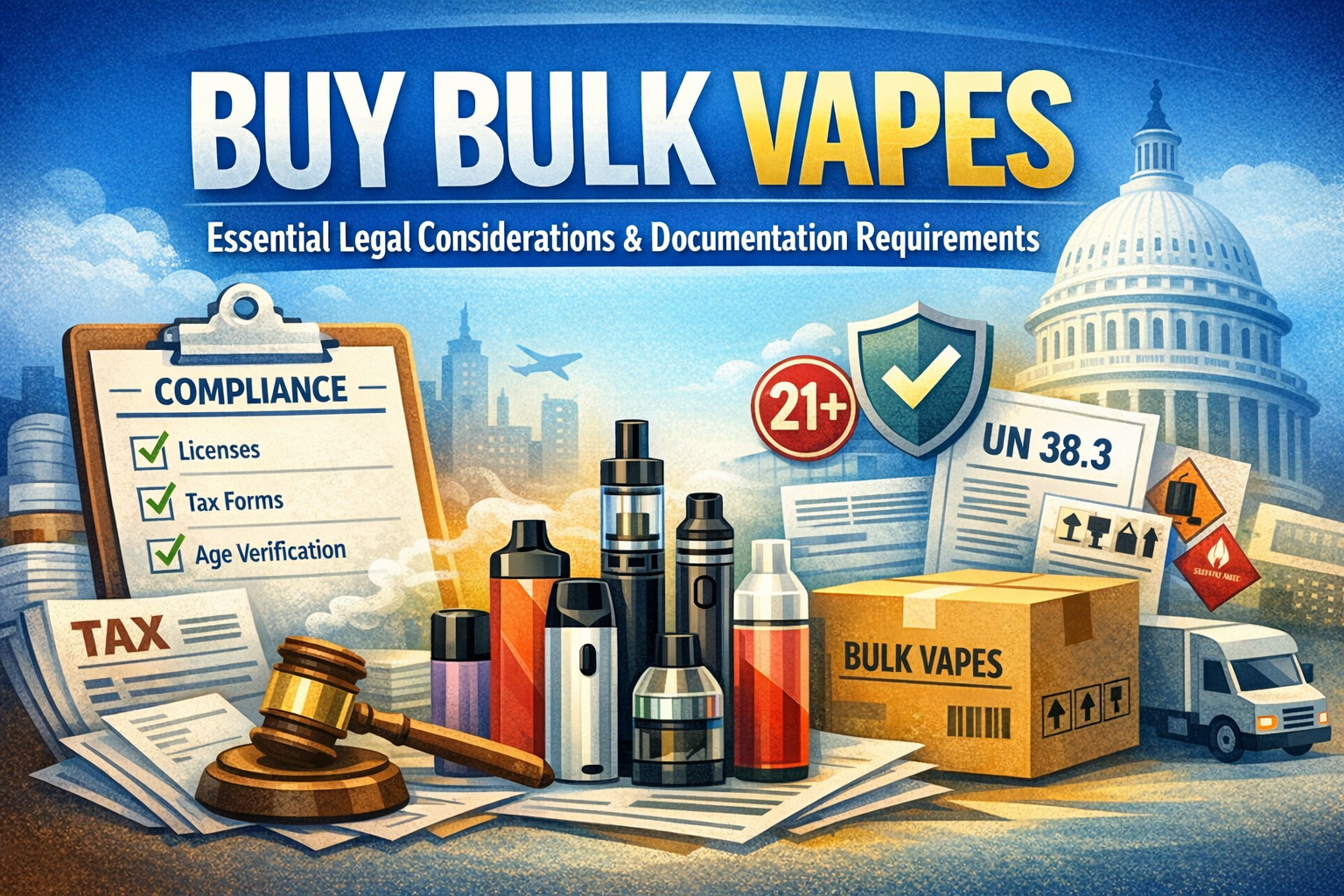
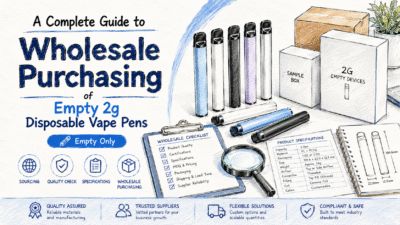
Buy Bulk Vapes: Essential Legal Considerations and Documentation Requirements
You need to follow laws from the federal, state, and local levels when you buy bulk vapes. Only empty vape devices, parts, and accessories are allowed. You cannot buy oil, nicotine, or THC. Many states require special licenses or permits to conduct vape-related wholesale transactions.
Key Takeaways
Check federal, state, and local vape laws before purchasing; verify all required permits.
Maintain organized compliance documentation to simplify inspections or audits.
Implement secure age-verification processes to meet Tobacco 21 standards (FDA).
Legal Requirements for Bulk Vape Purchases
Federal Laws and PACT Act
Under the PACT Act (ATF, 2021 Amendment), all ENDS distributors and online sellers must register with the Bureau of Alcohol, Tobacco, Firearms and Explosives (ATF) and applicable state tax agencies. They must also submit monthly reports and pay excise taxes in each jurisdiction where products are sold. According to Federal Register 86 FR 17956, USPS prohibits ENDS shipments; major private carriers such as FedEx and UPS maintain similar restrictions. Therefore, businesses should use authorized private logistics partners that maintain vape-handling compliance procedures.
Tip: Review ATF and state-level registration requirements before engaging in B2B shipments.
Requirement Area
Key Mandate
Impact on Business
Carrier Restrictions
No USPS, FedEx, UPS
Use approved private carriers
Age Verification
Check age at purchase/delivery
Use adult signature (21+)
Tax Compliance
Register & pay state excise taxes
Maintain tax records
Reporting
Monthly PACT filings
Keep detailed logs
State and Local Regulations
Each state has distinct ENDS policies. Some restrict flavored labeling; others impose registration, packaging, or excise-tax rules. Check your state commerce department or revenue website for current requirements before placing orders. Regulatory frameworks can change rapidly and may require updated certification.
Source: State Tobacco Control Laws Database (CDC, 2025 update).
ENDS Definitions and PMTA Rules
The FDA defines Electronic Nicotine Delivery Systems (ENDS) under 21 CFR §1100.3 as including “any component, part, or accessory of an ENDS device,” even when sold empty. However, PMTA (Premarket Tobacco Product Application) obligations apply only to products that contain or are intended for use with nicotine e-liquids. Empty-only devices are considered components and are not required to undergo PMTA review, though manufacturers must ensure compliance with applicable labeling and safety standards.
Note: Follow FDA guidance for ENDS components (updated June 2024) to verify labeling and component compliance.
Required Documentation
Business and Tobacco Licenses
Business License (Local Authority)
Tobacco Sales or ENDS Distributor Permit (State Level)
Reseller or Vendor License
Tip: Renew each license annually and keep digital records securely stored for inspection.
Seller’s Permit and Tax ID
Obtain a state-issued seller’s permit and a federal EIN/tax ID from the IRS to conduct legal wholesale transactions involving empty vape components.
Compliance Certificates and FDA Registration
Request certificates such as GCC (General Certificate of Conformity) and FDA manufacturer registration numbers. These documents demonstrate that products meet safety and labeling standards and are suitable for lawful distribution.
Lithium Battery Shipping Documents
Follow UN 38.3 testing and PHMSA 49 CFR §173.185 standards for lithium-ion battery transport. Obtain a UN 38.3 Test Summary and Safety Data Sheet (SDS) for each model to confirm compliance before shipment.
Source: U.S. DOT PHMSA Lithium Battery Guidance Document (January 2024).
Recordkeeping for Audits
Sales and Compliance Logs
Age Verification Records
Employee Training Records
Tip: Digital recordkeeping simplifies PACT reporting and federal/state audits.
Documentation Checklist Table
Document
Domestic
International
Battery
Purpose
UN 38.3 Test Summary
✓
✓
✓
Battery safety verification
Invoice / HS Code / COO
✓
✓
✓
Origin and customs compliance
SDS / MSDS
✓
✓
✓
Safety data compliance
Business License / Tax ID
✓
✓
✓
Proof of legal operation
Recordkeeping Log
✓
✓
✓
Supports regulatory audits
Packaging, Labeling, and Marketing Rules
Packaging and Warning Labels
Labels must not suggest nicotine presence if the product is empty. Include manufacturer details and comply with 16 CFR §1700 child-resistant packaging requirements. Packaging should truthfully represent capacity, compatibility, and materials used.
Marketing and Advertising Limits
Marketing should never target minors or use imagery that could appeal to youth. Avoid cartoon, candy, or recreational themes. Maintain compliance with 21 U.S.C. §387f(d) on modified risk statements.
Shipping Restrictions and PHMSA Rules
Shipments containing lithium batteries must be classified as UN 3480 (batteries only) or UN 3481 (batteries contained in equipment). Packages must carry the Class 9 hazard label and comply with PHMSA 49 CFR Part 173 and IATA DGR for air transport.
Action: Verify that all logistics partners maintain valid hazmat certifications per PHMSA standards.
Age Verification and Sales Limits
Federal law (Tobacco 21, FDA 2020) requires purchasers to be at least 21 years old. Use third-party ID verification tools (MyCheckr, ICU Lite) and retain proof for each sale to ensure compliance with 21 U.S.C. §387f(d).
How to Buy Bulk Vapes: Step-by-Step Workflow
Confirm legal requirements at the federal, state, and local levels.
Request and review UN 38.3 and SDS documentation from your supplier.
Ship using compliant private carriers under 49 CFR and IATA DGR.
Keep records for tax, compliance, and audit purposes.
Tip: Use a compliance checklist to verify documentation before every shipment.
Summary: To buy bulk empty vapes legally and safely, maintain valid licenses, tax IDs, and documentation. Follow PACT Act (ATF), FDA ENDS component rules, and PHMSA lithium battery regulations to ensure product integrity, supply chain compliance, and consumer safety.
FAQ
What documents do you need to buy empty vapes in bulk?
Business license, reseller permit, tax ID, UN 38.3 Test Summary, and SDS documentation.
Can you ship empty vapes with lithium batteries?
Yes, if you follow PHMSA 49 CFR §173.185 and maintain UN 38.3 Test Summary and SDS on file.
How do you prevent selling empty vapes to minors?
Implement third-party age verification tools and maintain digital records of every check as required under Tobacco 21 law.
A smoother experience begins with responsible product selection, careful inspection, clean handling, and awareness of warning signs. This guide provides

 ACE Ultra
 Muha Meds
 Big chief
 Besos
Besos Clean Carts
 Cookies
 Packman
 Sluggers
 Tyson pod
 Whole Melt
 California Honey
 USA Warehouse
 UK Warehouse
 POLAND Warehouse